<img src='https://news.cgtn.com/news/2025-07-25/Trump-s-tariff-deadline-approaches-what-we-know-so-far-1FiEP28eTwk/img/fb0bbf5423734e53aa8ed4d3cf28cb87/fb0bbf5423734e53aa8ed4d3cf28cb87.png' alt='U.S. President Donald Trump, first from right, during a Cabinet meeting at the White House in Washington, DC, U.S., July 8, 2025. /VCG'
U.S. President Donald Trump’s August 1 deadline for countries to sign deals or face hefty tariffs is fast approaching.
Trump delayed the so-called “reciprocal tariffs” in April, vowing then to strike roughly 90 trade deals in 90 days.
Where do tariffs stand now?
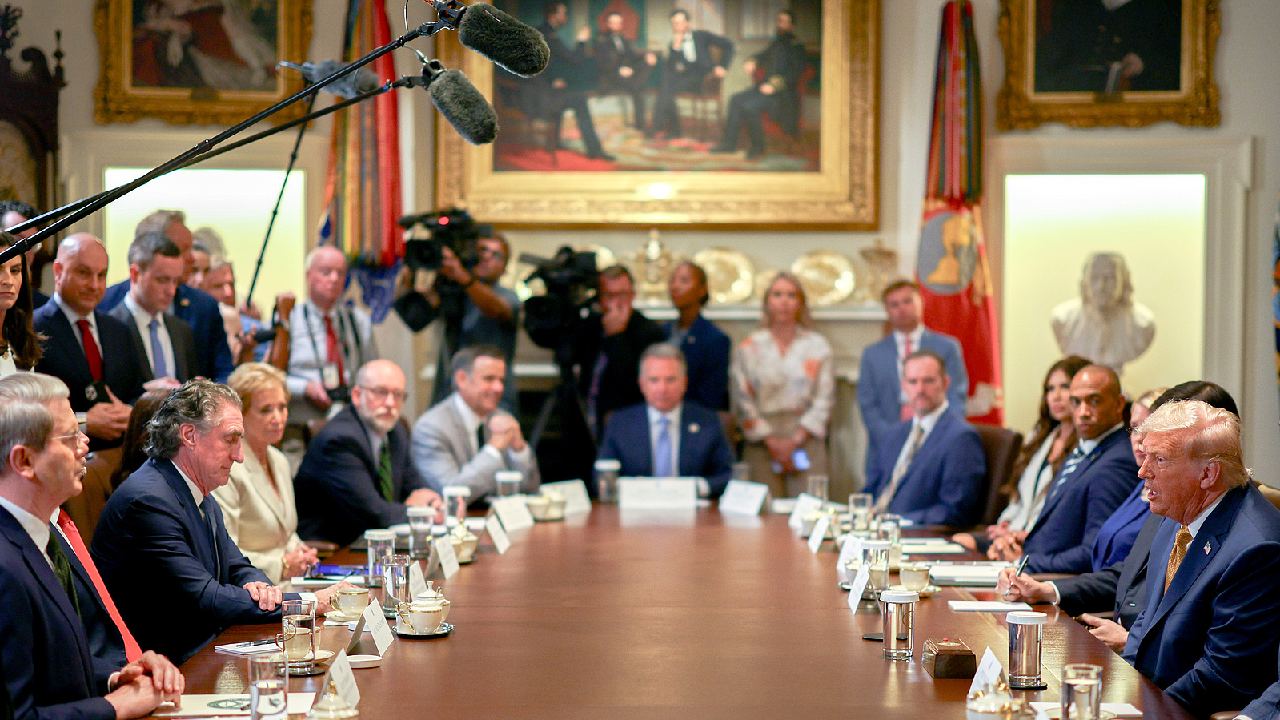
Trump appeared to raise the minimum U.S. tariff rate to 15 percent, up from the previous 10 percent, in remarks at an AI summit in Washington on Wednesday.
“We’ll have a straight, simple tariff of anywhere between 15 percent and 50 percent,” Trump said. “A couple of – we have 50 (percent) because we haven’t been getting along with those countries too well.”
That is an increase from current 10 percent duties in place on much of the world and comes after months of trade negotiations saw American trading partners searching for ways to lower rates to little apparent avail.
Trump has also placed a 50 percent tariff on steel and aluminum.
Goods from Mexico and Canada face tariffs of 25 percent, though the measure excludes products covered under the United States-Mexico-Canada Agreement.
Smaller U.S. trade partners are also set to face tariffs. For example, Cambodia and Bangladesh, two key sources of apparel imports, will face tariffs of 36 percent and 35 percent, respectively.
“The new tariff rates will come in,” U.S. Secretary of Commerce Howard Lutnick told CNBC last Sunday, while also acknowledging the possibility of continued negotiations: “Nothing stops countries from talking to us after August 1.”
<img src='https://news.cgtn.com/news/2025-07-25/Trump-s-tariff-deadline-approaches-what-we-know-so-far-1FiEP28eTwk/img/a76c45ce2dbd42c99c46efe1d4a5fb24/a76c45ce2dbd42c99c46efe1d4a5fb24.png' alt='An extra edition of a Japanese daily newspaper is published reporting that the U.S. and Japan agreed on a 15 percent tariff in Osaka City, Osaka Prefecture, Japan, July 23, 2025. /VCG'<img src='https://news.cgtn.com/news/2025-07-25/Trump-s-tariff-deadline-approaches-what-we-know-so-far-1FiEP28eTwk/img/51d3a83905b149f8a415e80a82b69c6d/51d3a83905b149f8a415e80a82b69c6d.png' alt='Transshipment containers at the Westhafen container terminal in Berlin, Germany, July 15, 2025. /VCG'
‘It has to be fair’
The EU recently said a deal with Washington that averts 30 percent tariffs is within reach. Meanwhile, the bloc has approved countermeasures in case talks collapse.
Brazil is ready to face 50 percent tariffs largely over Trump’s claims that it is treating a former president and Trump ally badly, as Brazilian officials suggested that hopes for a negotiated deal in the short term are diminishing.
For some, Trump’s action against Brazil indicates he’s trying to exert influence over more than trade.
“Trump seems to view tariffs as an instrument to influence not just other countries’ trade and economic policies but even their domestic legal and political matters,” Eswar Prasad, professor of trade policy at Cornell University, told AP.
As for Trump’s touting and appeal to other countries to open their markets to U.S. goods in multiple trade talks, Chad Bown, senior fellow at the Peterson Institute for International Economics, told AP that, “For each of these countries, they have their own domestic challenges about what they can and can’t offer.'”
“There’s a reason why that market access hasn’t been granted before. They have domestic political constituencies that argue to keep protection in place.”
Malaysia, for instance, has “specific red lines” it will not cross, Malaysian Trade Minister Zafrul Aziz said on Wednesday, including U.S. demands involving government contracts, halal certification, medical standards and a digital tax.
“It has to be fair,” the Malaysian trade minister said. “If the deal does not benefit Malaysia, we should not have a deal.”
The deals done
So far, the U.S. has reached trade agreements with the UK, Vietnam, Indonesia, Japan as well as a preliminary accord with China.
In latest developments, the United States reached trade deals with Japan and the Philippines. The U.S.-Japan deal saw tariffs on a variety of products move to 15 percent.
Under the U.S.-Philippines deal, the Philippines will go to “open market” with the U.S. paying a 19 percent tariff, while U.S. exports will face no import tax in the country.
Earlier in July, the U.S. and Indonesia struck a trade pact, which showed a 19 percent tariff imposed on Indonesian goods with no duties levied on 99 percent of U.S. imports.
Vietnam also reached a deal with the U.S. earlier July. Under the deal, Vietnam will face a 20 percent tariff for its exports to the U.S., while U.S. products can access Vietnam’s market tariff-free.
The tariff deals come as prospects for larger pacts with India, Canada and the European Union remain in question. Trump has threatened 25 percent to 35 percent tariffs on those larger trade partners.
(With input from agencies)