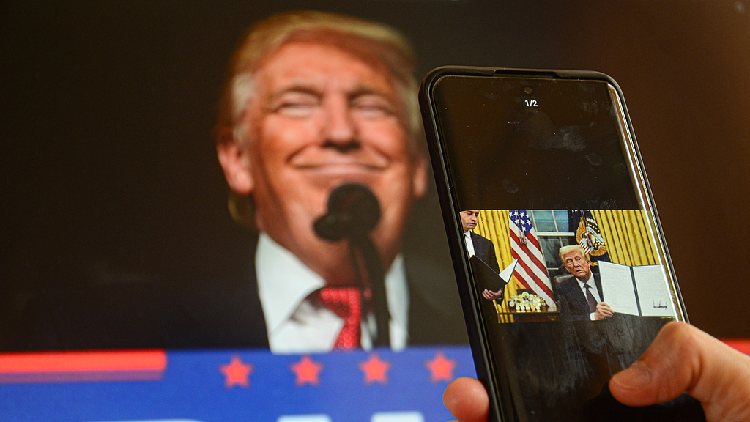
Ladies and gentlemen, gather around for today’s episode of “How to Start a Trade War Using Kindergarten Math”! The Trump administration has unveiled its latest masterpiece: a tariff formula so “reciprocal,” it’s like charging your neighbor rent because their lawn is greener. Let’s break down this artisanal economic logic, freshly baked in the oven of chaos.
<img src='https://news.cgtn.com/news/2025-04-19/US-administration-s-trade-deficit-math-When-2-2-Tax-the-penguins-1CHwLBl3LZC/img/ba0590c338a948d687f81b611d4dcb3d/ba0590c338a948d687f81b611d4dcb3d.jpeg' alt='US President Donald Trump displays a signed executive order after announcing a set of "reciprocal tariffs" on other nations in Washington, DC, April 2, 2025. /VCG'
Step 1: Define “reciprocal” as “Whatever I feel like”
The White House’s big-brain formula? Take the US trade deficit with a country, divide it by imports, and — poof — you’ve got their “hidden tariff rate”!
Tariff policy now works like a dating app for insecure nations. America swipes right, sends over $100 billion worth of purchasing power. Wakanda responds with a polite $10 billion purchase of bald eagle socks. And the US is like, “What the hell?! We’ve been ghosted! That’s a 90 percent disrespect rate!” So what does the White House do? It cranks up tariffs like it’s rage-texting at 2 a.m.:”You never loved us anyway!!! BLOCKED.”
Turns out, trade deficits aren’t about love or betrayal. They’re about economic structure, currency strength, and whether anyone needs 40 metric tons of freedom-flavored chewing gum. But try telling that to a guy screaming “reciprocity” into a calculator.
<img src='https://news.cgtn.com/news/2025-04-19/US-administration-s-trade-deficit-math-When-2-2-Tax-the-penguins-1CHwLBl3LZC/img/603c31ac50f341308088bb890a4bbdbc/603c31ac50f341308088bb890a4bbdbc.png' alt='The Trump administration's tariff formula. /Screenshot from ustr.gov'
Step 2: Ignore basic economics (and reality)
Trump’s team used two elasticities:
“Import demand elasticity” (ε = -4): Because Americans stop buying Ferraris if the price rises by $0.50. “
Tariff pass-through” (φ = 0.25): Because only 25 percent of tariffs hit consumers. The rest? Magic!
Except real economists say φ is 0.945 — meaning 94.5 percent of tariffs get passed to consumers. Oops! But why let facts ruin a good story? As the famed comedian Jon Stewart quipped, “Why bother checking your math when you can just blame fake news?”
<img src='https://news.cgtn.com/news/2025-04-19/US-administration-s-trade-deficit-math-When-2-2-Tax-the-penguins-1CHwLBl3LZC/img/dd58d077ee604332aee9e4d0a5488fda/dd58d077ee604332aee9e4d0a5488fda.jpeg' alt='A Chinese citizen watches tariff-related news on a mobile phone in Jiangmen City, Guangdong Province, April 13, 2025. /VCG'
Step 3: Tax penguins and call it patriotism
Let’s not forget the penguin-populated islands slapped with tariffs. Because nothing screams “America First” like punishing flightless birds for … existing? In a perfect display of headline grabbing protectionism, the administration imposed a 10 percent “America First” tariff on Heard and McDonald Islands wildlife — only Australian territories inhabited solely by penguins and seals— and touted it as a bold defense of US industry.
<img src='https://news.cgtn.com/news/2025-04-19/US-administration-s-trade-deficit-math-When-2-2-Tax-the-penguins-1CHwLBl3LZC/img/9ae7df729cf34abab40809ec5b39da4b/9ae7df729cf34abab40809ec5b39da4b.png' alt='King penguins standing on the shores of Corinthian Bay in the Australian territory of Heard Island in the Southern Ocean. Photo by Matt Curnock. /VCG'
Conclusion
In the end, it’s less about trade policy and more about performance art with spreadsheets. The message is clear: if it moves, tax it; if it doesn’t, blame it; if it waddles and eats fish, slap a tariff on it just in case. Welcome to the new economic order — where math is optional, logic is emotional, and somewhere, a penguin is wondering what it did wrong.